Most companies can name their tier-1 suppliers without looking. Ask about tier 2, the suppliers behind those suppliers, and the room goes quiet. That silence is where the next disruption is already sitting.
I spent years assessing supply chain risk for programs where a single unseen dependency could stop a mission. The pattern never changed. The failure almost never started with the supplier on the contract. It started one or two levels down, with a sub-tier source nobody had mapped, in a region nobody was watching, feeding a part nobody had flagged as critical until the line stopped.
There are three reasons tier-2 blindness persists, and none of them is a lack of effort.
First, contracts create a false sense of coverage. Your agreement is with tier 1, so your visibility ends there, even though your exposure does not. Your tier-1 supplier’s problems become your problems on their schedule, not yours, and usually with less warning than you need.
Second, the data lives in pieces. Purchase orders in one system, shipping records in another, ownership and financial information somewhere else entirely. Nobody owns the job of putting those pieces together into one picture of who actually supplies you, so the picture never gets built.
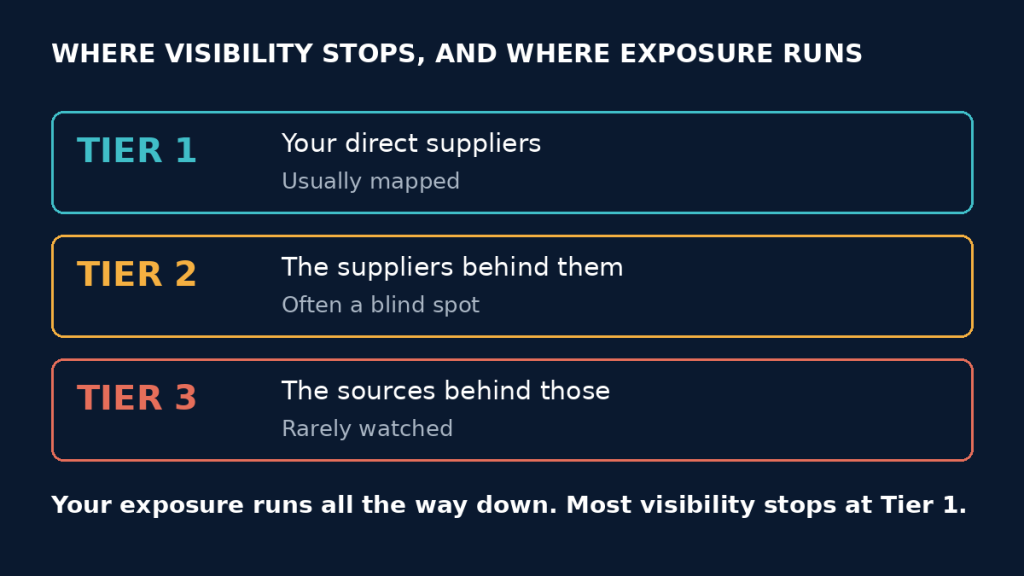
Third, mapping feels like a project with an end date. It is not. Suppliers change owners, move production, and add sub-sources constantly. A map that was accurate eighteen months ago is a historical document today.
The fix is not a bigger spreadsheet. It is a standing discipline:
- Map to the part, not to the supplier. Start with your most critical parts and components, and trace each one back through every tier that touches it.
- Watch ownership and geography, not just delivery performance. A financially sound supplier under new foreign ownership, or concentrated in one flood zone, is a different risk than the one you qualified.
- Put the sensing on a rhythm. Recently, I have been using AI tools, including Claude, ChatGPT, and Gemini, in human-reviewed workflows to scan trade and ownership data for exactly these changes. The tools surface signals faster than any manual review I have run. The judgment about what a signal means, and what to do about it, stays with people. That division of labor is the whole point.
- Rehearse the bad day. A map that nobody has tested against a real scenario is decoration. Pick your three most painful single points of failure and walk the team through losing each one.
At The Corporate Looking Glass, this is the work we do with clients: build the map, rate the risk, and rehearse the response before the disruption picks the date. The companies that come through a supply shock intact are rarely the ones with the most suppliers. They are the ones who could see theirs.
Here is my question for you: when did you last learn something about a tier-2 or tier-3 supplier that you wished you had known a year earlier, and what did it cost you?
My own answer, to start us off: mine involved a sub-tier source whose ownership had changed hands quietly, and on paper nothing about our supply looked different. The part kept arriving. The risk had doubled. I have never trusted a tier-1-only view since.
Follow The Corporate Looking Glass for more on building a supply chain you can actually see, and tell me your tier-2 story in the comments.
Donna J. Broussard, PhD
The Corporate Looking Glass LLC (TCORLG)